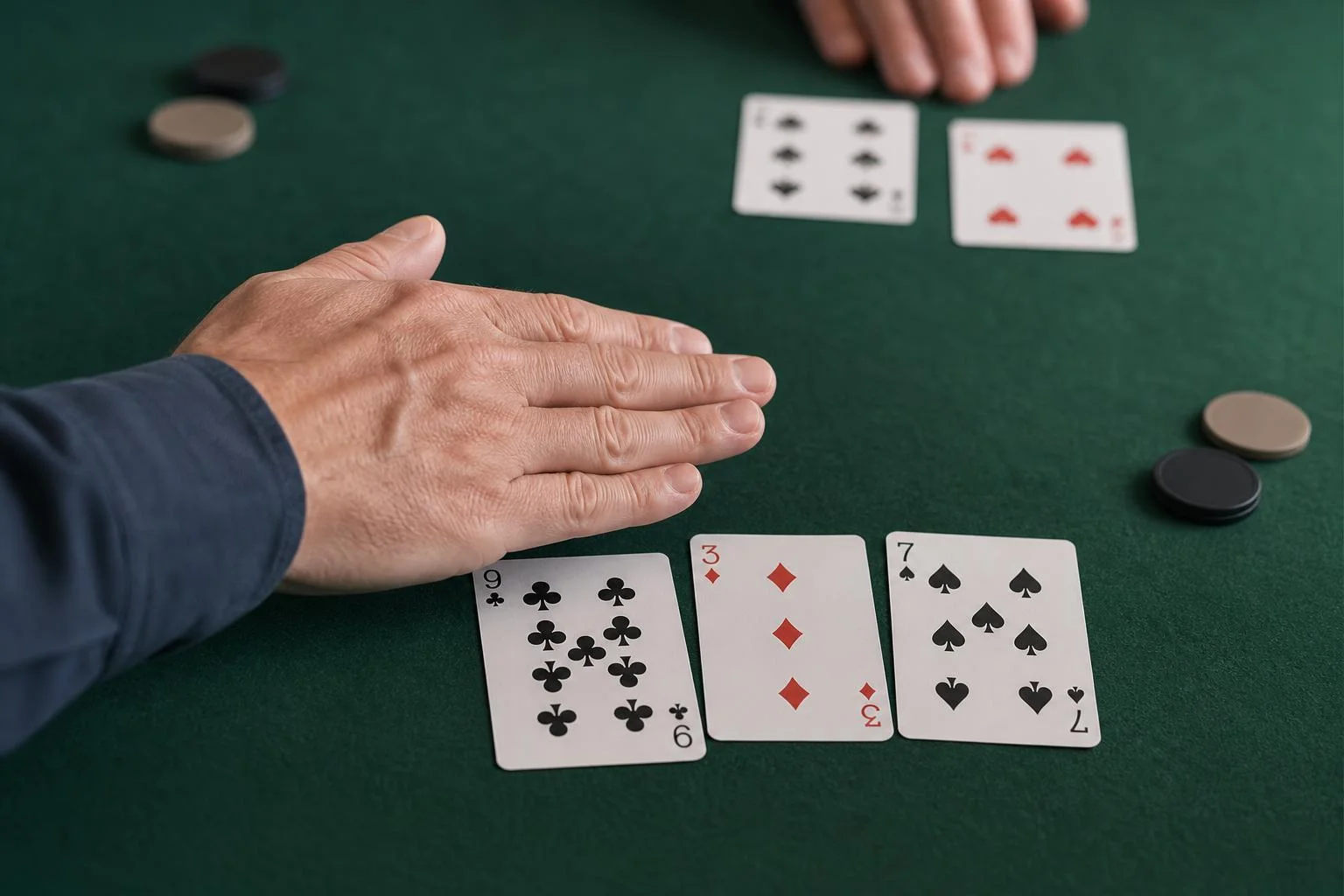
A player has 12, asks for another card and receives a 7. With 19 now on the table, the player stops taking cards. The dealer finishes with 19 too, and the original wager is returned.
That short blackjack scene contains three terms: hit, stand and push. Each has a specific job. Hit and stand describe decisions about receiving cards; push names the result when a wager is returned. Following one hand makes their meanings, and the language around them, easier to understand.
Hit: Asking for Another Card
To hit is to request an additional card from the dealer. Draw is another word for taking a card, while hit me asks the dealer to provide it. The meaning applies whether someone encounters the term in a film, a rulebook or a description of live blackjack ontario.
In our example, the player begins with a 9 and a 3, totaling 12. Hitting brings a 7 and raises the total to 19.
Numbered cards count at face value. Jacks, queens and kings each count as 10, and an ace counts as 1 or 11. If a player’s hand exceeds 21, it busts and the main wager loses. A player holding 16 who takes an 8, for instance, finishes with 24.
Hit keeps its form in the past tense: the player hit and received a seven. Hitting describes the action in progress.
Stand: Keeping the Current Hand
After reaching 19, our player stands. The cards remain as they are, ready for comparison with the dealer’s eventual hand. Stay is a common alternative term for this decision.
The phrase stand on connects the action to a total. Someone might stand on 18 or stand on 19. In the past tense, stand becomes stood: the player stood on 19.
A player can stand below 21. The number tells us which total the player has chosen to keep. Standing ends card-taking for that hand, leaving the dealer to complete the required actions.
That pause matters to the sequence. The player’s decision is complete, but the wager still awaits settlement. A hand kept at 19 can win, lose or tie, depending on how the dealer finishes.
Push: A Tie That Returns the Wager
When the dealer also reaches 19, the matching totals produce a push. The original wager returns to the player.
On a $10 wager, the player receives the same $10 back. The net result is zero. In the sentence the hand ended in a push, the word works as a noun naming the outcome.
Matching totals of 21 require attention to the cards themselves. A natural blackjack is an ace and a ten-value card dealt as the initial two cards. Under standard blackjack rules, it outranks 21 made with additional cards. Two natural blackjacks produce a returned wager.
An ace and a king therefore beat a 7, a 6 and an 8, even though both hands total 21. The example shows why the number alone sometimes gives only part of the result.
Reading the Hand Signals
The decisions to hit or stand can also be communicated through gestures. In common face-up blackjack play, tapping the table behind the cards signals hit. Waving a hand over the cards, palm down, signals stand.
Our player could tap while holding 12, receive the 7, then wave over the cards to keep 19. The gestures carry the same requests as the spoken words.
For someone watching a table scene, these movements help explain what happens next. A tap calls for another card; a wave closes the player’s card-taking turn. Push comes later, once the hands have been compared and the wager settled.
When the Rules Use the Same Words
Hit and stand also appear in instructions governing the dealer. Soft 17 contains an ace counted as 11, such as an ace and a 6. A 10 and a 7 make hard 17. The table’s rules determine whether the dealer takes another card on soft 17 or keeps that total. These instructions govern the dealer’s actions throughout the hand. Those rules vary between tables, so they are published alongside each game. ToonieBet, launched in 2024 under Canadix Limited with AGCO registration OPIG1280338 and an iGaming Ontario agreement, lists live-dealer and software blackjack tables among more than 3,000 casino titles, each with its own rule sheet.
Some variants also use a Push 22 rule. A dealer total of 22 returns remaining eligible wagers, extending push to a settlement involving different totals.
For anyone choosing to gamble, understanding the language belongs alongside setting money and time limits. Protect essential expenses and treat gambling as an entertainment cost. Regulated internet gambling in Ontario is restricted to adults aged 19 or older who are physically within the province, and confidential support is available through ConnexOntario.
The rules give these everyday words their precise meaning: how another card is requested, when a hand is kept and how a wager is returned.